Our convictions

Trained in agro-development, Thomas has been aware since his studies of sustainable development, the importance of biodiversity and agroecology, as well as the place of man in agricultural land.

agro-vin

Our convictions

Trained in agro-development, Thomas has been aware since his studies of sustainable development, the importance of biodiversity and agroecology, as well as the place of man in agricultural land.

Our convictions

Trained in agro-development, Thomas has been aware since his studies of sustainable development, the importance of biodiversity and agroecology, as well as the place of man in agricultural land.

Organic viticulture and agro ecology

From the very first years of taking over the estate, and contrary to purely economic and financial considerations, we committed the entire estate to converting to organic farming. This strong commitment stems from a desire to live in accordance with our convictions, out of respect for the environment, the vines and the soil, out of respect for the men and women who work there, and finally, out of respect for all those who drink the estate’s wines. The estate and its wines obtained Ecocert certification in 2013.

In the vineyards, each plot follows its own unique path. Our soils, with their rather acidic profile and dark color, are characterized by their excellent drainage. Drying out very quickly, the windows of opportunity for working the soil are narrow, making organic farming particularly demanding. Depending on the year’s weather patterns, some plots are naturally covered by spontaneous vegetation, while others are sown with green manure to improve soil fertility.

Since 2020, hedgerows and fruit trees have been planting around and within our vineyards, enhancing our landscapes. We are still in the experimental phase, but we have embraced the agro-ecological benefits of these choices: providing natural shade, protection against harsh weather, enriching the soil (with organic matter), sequestering carbon from the air, and promoting mycorrhizal symbiosis.

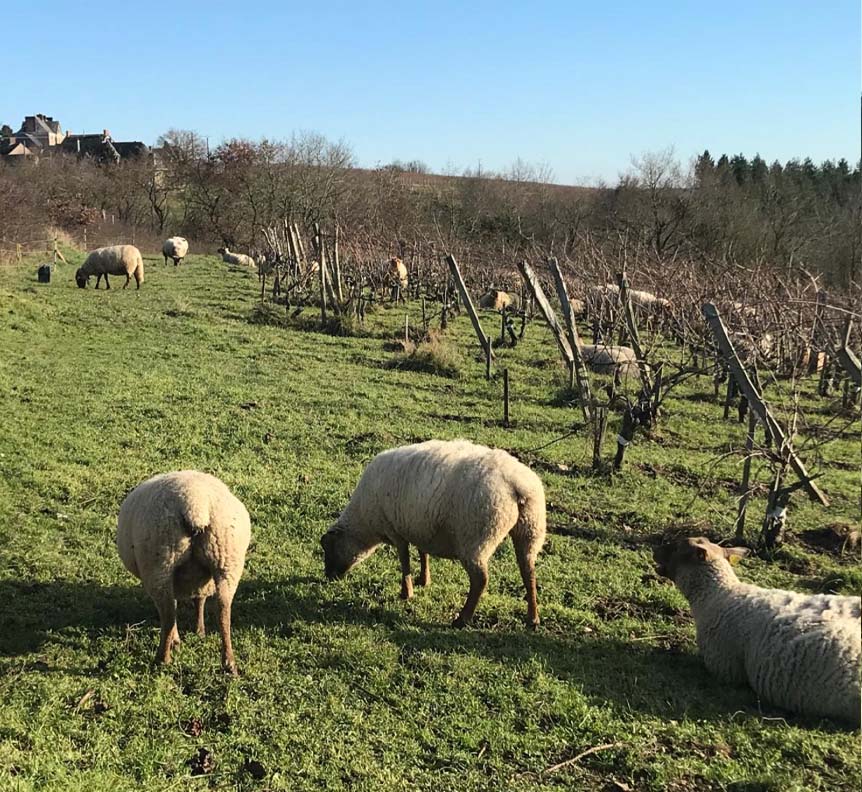
In winter, some of our plots welcome sheep from a neighboring sheepfold. By grazing, they help us get a head start on the growing season and bring life to our vineyards.


Plants, our allies!

Widely used in the family for personal health, aromatic and medicinal plants have a natural place in vine care. Plant extracts are used in many different forms: infusions, decoctions, purines, and essential oils. Their properties are very useful in combating spring frosts, stimulating soil and plant activity, boosting the vine’s immune defences, and fighting fungal diseases, thus reducing the amount of copper used in treatments.

The main plants used are nettle, horsetail, osier, yarrow, chamomile, dandelion, etc.

Le Clos des Amandiers: a showcase of our expertise

On a plot of land that had lain fallow for 10 years in the heart of the Aiglerie terroir, we planted in 2022 and 2023 the grape varieties that, in our view, best represent our identity: Cabernet Franc, Pineau d’Aunis, and Gamay for the reds, and Chenin Blanc and Grolleau Gris for the whites. The entire area forms a walled vineyard, bordered by banks planted with fruit trees and hedgerows, and shelters a diverse and indigenous grape variety planted in squares separated by rows of almond trees.

This choice reflects an awareness of the fragility of the wine-growing ecosystem in the context of climate change, but also an aesthetic desire to showcase the work done in the vineyards and the Anjou terroir. It is about preserving the landscape and heritage of the vineyards.

Logo Terre de l'Elu
Logo Terre de l'Elu